
Well-being economics evaluates economic progress by asking whether people’s lives are improving, not only whether production is growing. GDP remains useful, but it cannot show on its own who benefits, what social or environmental costs arise, or whether today’s gains can last. A broader view helps policymakers, organizations, and communities connect results with their human consequences.
Key takeaways
- Use GDP to understand economic activity, not as a complete measure of social progress.
- Track lived outcomes such as health, secure work, housing, safety, and social connection.
- Report who benefits and who is left behind, rather than relying only on averages.
- Include the social, economic, and natural resources needed to sustain well-being over time.
- Use indicators to improve decisions, not to reduce human lives to a single score.
GDP is useful, but it cannot tell the whole story
GDP measures the value of goods and services produced in an economy. It can help explain changes in output, but it does not by itself show how income is distributed, whether people feel secure, or whether economic activity improves health and opportunity.
That distinction matters because the same rise in production can accompany very different human outcomes. A community might see more jobs while residents face unaffordable housing or long commutes. The headline number can rise without showing whether people have more time, stability, or meaningful choice.
The OECD’s well-being framework treats economic outcomes as part of a broader picture of current living conditions, inequalities, and resources for future well-being. This is a practical way to keep growth in view without confusing it with the purpose of an economy.
Well-being includes material security and quality of life
Well-being is a combination of the conditions people live with and how they experience their lives. Income matters because it enables choices and helps meet needs, but it is only one part of a decent life.
The OECD framework covers 11 dimensions of current well-being, including income and wealth, housing, work quality, health, education, environmental quality, safety, social connections, and subjective well-being. It also considers four types of resources that support future well-being: economic, natural, human, and social capital.
| Dimension | Useful indicators to consider | Question for decision-makers |
|---|---|---|
| Material security | Income, housing costs, job quality | Can people meet essential needs with stability? |
| Health and capability | Life expectancy, access to care, learning | Can people stay healthy and develop their abilities? |
| Relationships and agency | Social connection, safety, civic participation | Do people feel connected and able to shape decisions? |
| Environmental conditions | Local air quality, access to nature, resource use | Are current gains compatible with a livable future? |
The Human Development Index offers one established example of a measure that combines health, education, and standard of living. The UNDP’s HDI explanation also notes that this summary measure does not capture everything, including inequality, poverty, empowerment, and human security. That is why no single index should stand in for a full account of people’s lives.
A useful dashboard shows outcomes, gaps, and future costs
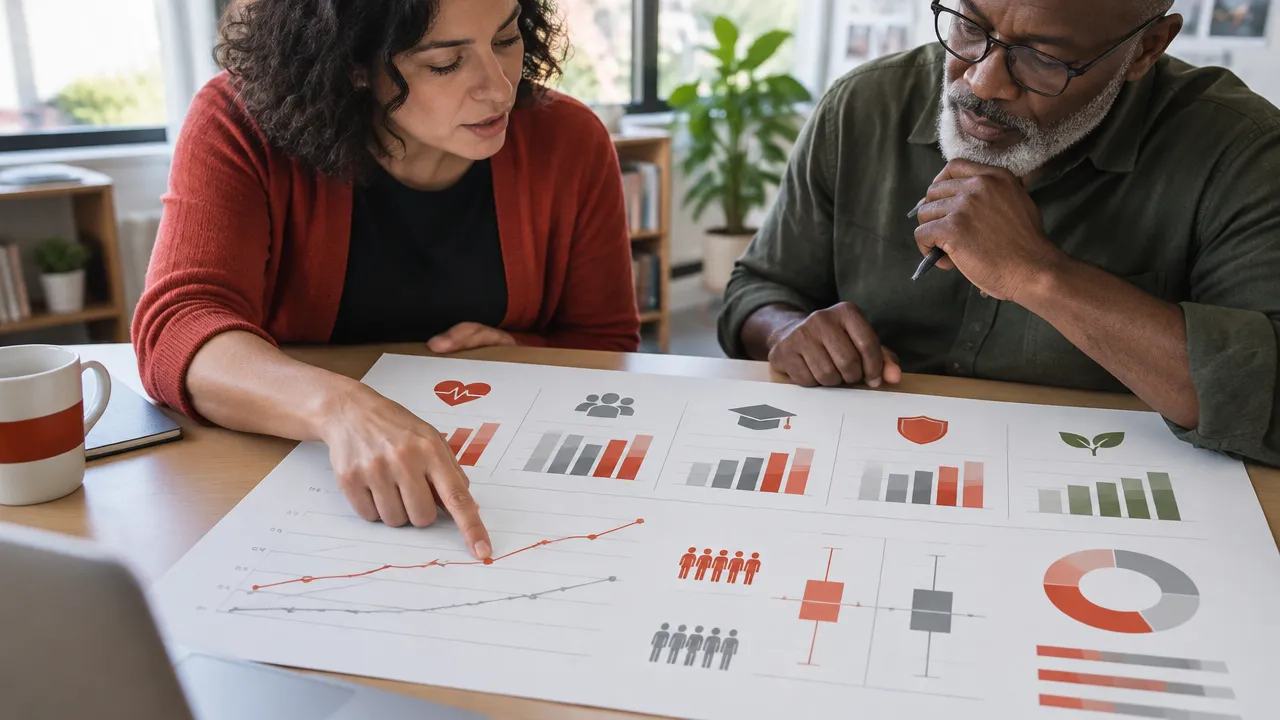
A practical progress dashboard should answer three distinct questions: Are lives improving now? For whom are they improving? Are the conditions for future well-being being protected?
For example, a city tracking employment could pair job numbers with measures of wage adequacy, schedule predictability, commuting time, and differences between neighborhoods. This helps show whether employment growth is translating into greater security, or whether its benefits and burdens are unevenly shared.
The OECD Well-being Data Monitor brings together more than 80 indicators and includes views of current outcomes, differences between population groups, and resources that shape future well-being. Its structure illustrates why a clear dashboard is more useful than one composite score: readers can see both progress and the places where it is incomplete.
Better measures change how decisions are judged
Indicators matter when they change what leaders ask before approving a policy, investment, or organizational target. Instead of asking only whether a project raises output, decision-makers can also ask whether it improves access, reduces harm, and preserves conditions people depend on.
Consider a transport investment. In addition to its cost and expected economic activity, a well-being assessment could examine whether residents can reach work, school, and health services safely, how travel burdens vary by neighborhood, and what environmental effects follow. These measures do not dictate one answer; they make consequences visible before a choice is treated as successful.
Organizations can apply the same principle by pairing conventional performance measures with human impact metrics. Connecting outcomes to responsibility makes it harder to celebrate results that depend on avoidable harm, and easier to recognize value that improves people’s lives. For a related organizational perspective, reporting on employee well-being can help bring lived experience into performance conversations.
Good measurement needs safeguards against oversimplification
A well-being dashboard is not automatically fair or wise. Measures can conceal as much as they reveal if definitions are unclear, data are outdated, or averages hide unequal outcomes. Surveys also need careful interpretation: a person’s reported life satisfaction can add valuable context, but it cannot replace measures of material conditions and access to essential services.
Use a balanced set of indicators, publish how they are defined, and show results across relevant population groups. Treat any combined score as a summary, not a verdict. The UNDP’s description of the HDI makes the limitation clear: even a thoughtfully designed index captures only part of human development.
Finally, avoid turning every indicator into a target. Once a measure becomes a target, institutions may focus on improving the number rather than the underlying experience. Regularly review whether the measures still reflect what communities value, and include people affected by decisions in that review.
Frequently asked questions
What does well-being mean in simple terms?
Well-being means how well people are able to live, not just how much money they earn. It includes essentials such as safety, health, housing, and income, as well as relationships, choice, and a healthy environment. A useful measure considers both people’s lived experiences and the conditions shaping them.
What is well-being economics?
Well-being economics is an approach to organizing and evaluating economic activity by its effects on people and the environment. It treats output and income as important means, not the final measure of success. Its goal is to understand whether economic decisions improve lives fairly and sustainably.
How can a country measure progress beyond GDP?
A country can track GDP alongside indicators for health, education, housing, job quality, safety, environmental conditions, social connection, and people’s own assessments of life. It should also examine how outcomes differ between groups and whether today’s gains are supported by resources that can last.
Does GDP still matter in a well-being economy?
Yes. GDP helps show the size and direction of market production, so it remains useful for economic analysis. It does not show who benefits, whether health or security improves, or whether growth depends on damaging future resources. A broader dashboard keeps GDP in context rather than discarding it.
Why should well-being indicators be broken down by population group?
Breaking indicators down by age, income, location, gender, or other relevant groups reveals whether average gains reach people facing the greatest barriers. A national average can rise while some communities fall behind. Disaggregated results help decision-makers identify who benefits, who bears costs, and where policy needs to change.